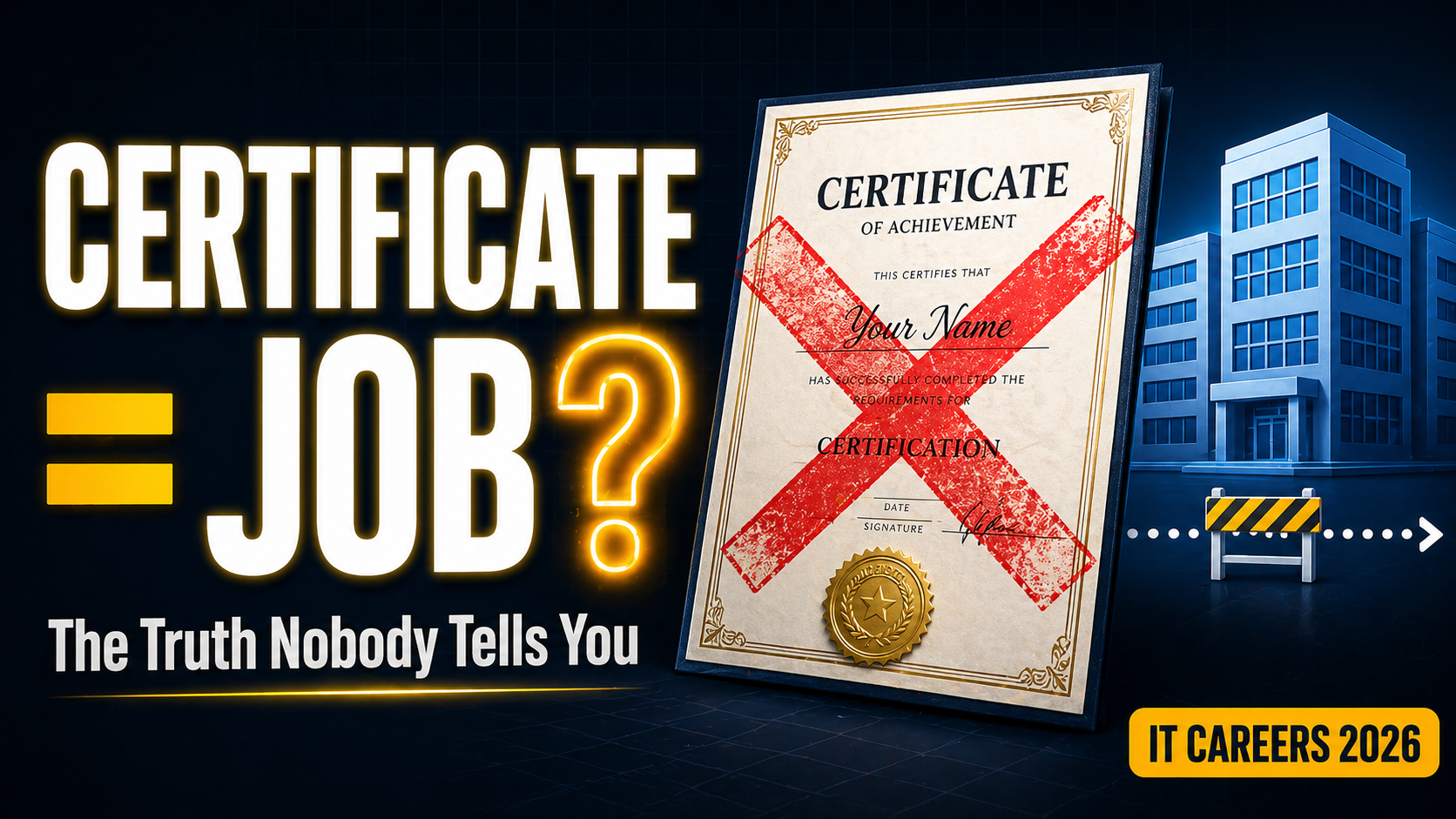
Do IT Certifications Really Get You a Job in 2026? The Truth
Certifications alone won’t land you an IT job in India. We break down what actually matters – from resume screening to cracking technical interviews in 2026.
Every year, thousands of Indian engineering graduates and IT aspirants spend months – and sometimes serious money – chasing certifications, believing that a shiny badge will open every door. We have seen this happen in our community too many times, and honestly, it is time someone said the quiet part out loud. A certification alone will not get you hired.


That does not mean certifications are useless. They serve a specific, limited purpose – and once you understand exactly what that purpose is, you can stop wasting time and start building the kind of profile that actually gets you through the door and past the technical round. Let us walk through what we have seen, what we have tested by talking to hiring engineers, and what nobody in those paid course ads will ever tell you.
What Do Certifications Actually Do for Your IT Career?
Here is the honest answer: certifications help you clear the first filter. When a company posts a job opening and 400 people apply within 48 hours, the recruiter or the ATS (Applicant Tracking System) needs a way to shortlist. Having a recognised certification – whether it is AWS, CompTIA, Cisco, or Google Cloud – can get your resume past that automated or human first-pass screening. That is genuinely useful, and we will not pretend otherwise.
But here is where a lot of beginers go wrong. They treat clearing the screening as the finish line, when it is actually just the starting gate. The real competition begins at the technical interview, and no certificate in the world can answer questions for you in that room – or on that video call.
If you are exploring which certifications are even worth pursuing at the beginner level, we have covered the landscape in detail. Our post on beginner cloud certifications walks through which ones give you the best return for the time and money you put in – because that choice matters too.
Why Won’t Companies Hire You Based on a Certificate Alone?
Think about this from the employer’s side for a moment. A company is paying someone a salary to do real work – configure servers, secure networks, write scripts, diagnose production issues. They cannot afford to hire someone who memorised exam dumps but has never actually done any of these things. When we first started following hiring discussions in IT communities, this came up again and again: interviewers are specifically trained to find the gap between what is on your resume and what is actually in your head.
The technical interview exists precisely for this reason. It does not matter whether you are a fresher or someone with five years of experience – if you cannot demonstrate real working knowledge when the interviewer asks you to walk through a scenario, explain a concept in your own words, or solve a problem on the spot, the certificate becomes irrelevant. We have heard directly from hiring engineers that they sometimes prefer a confident, hands-on candidate with no certification over a certified candidate who cannot explain the basics clearly.
📌 “A certificate gets your resume noticed. Your knowledge gets you hired. Do not confuse the two.”
What Do Technical Interviewers Actually Test in IT Hiring Rounds?
Nobody explains this part clearly in most career advice videos, but we will. Technical interviews in IT roles – whether it is networking, cloud, sysadmin, DevOps, or development – are designed to test applied understanding, not textbook recall. Interviewers ask situational questions, give you troubleshooting scenarios, and sometimes ask you to explain things as if you were teaching a junior. These are not things you can fake with a certificate number.

For example, if you are going for a junior networking role and you have a CCNA on your resume, the interviewer will immediately go deeper – subnetting on the spot, explaining how a specific routing protocol behaves under failure conditions, describing what you would check first when a client cannot access the internet. We have put together a detailed resource specifically on this. If you are preparing for something like this, check out our guide on junior networking engineer interview questions – it covers real questions from real hiring rounds.
Here is a rough breakdown of what technical interviewers are actually looking for at different stages:
| Interview Stage | What Is Being Tested | Can a Certificate Help Here? |
|---|---|---|
| Resume Screening | Keywords, credentials, formatting | Yes – directly useful |
| HR Round | Communication, salary expectations, availability | Marginally – adds credibility |
| Technical Round 1 | Core concept understanding, scenario-based questions | Only if backed by real knowledge |
| Technical Round 2 | Deep troubleshooting, practical tasks, live demos | No – pure skill matters here |
| Managerial Round | Problem-solving approach, teamwork, attitude | No – soft skills and experience |
How Should Freshers Balance Certifications and Practical Skills?
This is the question a lot of students in our community ask us, and our honest take on this would be: do not choose one over the other – sequence them correctly. Build the practical skill first, then validate it with a certification. Most people do it backwards. They get the certificate hoping the knowledge will follow, and it usually does not.
For instance, if you want to break into cloud computing, spend 4 to 6 weeks actually using AWS or Google Cloud Free Tier. Build something – a static website, a simple serverless function, a basic VPC setup. Get confortable with the console, the CLI, and the billing dashboard. Then study for the certification. When you sit in front of an interviewer and they ask about your AWS experience, you have real examples to talk about. The certification just confirms what you already know.
The same logic applies to programming. If you are building towards an IT career and you want to add a Python credential, make sure you can actually write scripts, automate tasks, and debug code before you put that certification on your resume. We have a detailed roadmap for this in our Python master class for beginners – it is the kind of structured, self-driven learning path we recommend over any paid boot camp.
Which IT Certifications Are Worth Pursuing in 2026?
We will not pretend all certifications are equal. Some carry genuine weight with IT recruiters and MNCs. Others are expensive pieces of paper that barely move the needle. Here is what we have observed from the hiring landscape in 2026.
The certifications below are worth your time – but only after you have built real skills in those domains:
- AWS Certified Cloud Practitioner / Solutions Architect – Highest recognition in Indian MNCs and startups. Free Tier gives you real practice. Exam costs roughly Rs. 9,000 to Rs. 12,000 depending on the level.
- CompTIA A+ and Network+ – Strong entry-level recognition, especially for support and networking roles. Available on Amazon India study material for under Rs. 2,000.
- Cisco CCNA – Still the gold standard for networking roles in India. Takes serious study time but is highly respected. Exam costs around Rs. 25,000.
- Google Associate Cloud Engineer – Growing demand as Google Cloud adoption increases in Indian enterprises.
- Microsoft AZ-900 / AZ-104 – Very relevant if you are targeting companies using Microsoft Azure stack, which is a significant portion of the Indian enterprise market.
- Red Hat RHCSA – Excellent for Linux and sysadmin roles. Highly practical exam format – you cannot pass by memorising dumps alone.
One caveat worth keeping in mind: this list reflects what carried weight with recruiters at the time of writing. Certification value shifts as vendors retire exams, rename tracks and launch replacements, and as hiring priorities move with the market. Before you commit money or months to any of these, check that the exam is still current and still being asked for in the job postings you are actually targeting.
📌 Official Resource: AWS offers free digital training that pairs well with certification prep – no paid course needed to get started. Visit AWS Free Digital Training
📌 Official Resource: Google Cloud Skills Boost offers free and low-cost hands-on labs – the best way to prep for Google certifications with actual cloud experience. Visit Google Cloud Skills Boost
What Mistakes Do Certified Candidates Make That Cost Them the Job?
A lot of beginners make this mistake: they study specifically for the exam and not for the job. Exam prep and job prep overlap, but they are not the same thing. Certification exams test you on a fixed syllabus with multiple-choice answers. Job interviews test you on open-ended problems where you have to think out loud, defend your reasoning, and admit what you do not know while explaining how you would find out.


Here are the most common patterns we have seen from candidates who failed technical rounds despite having valid certifications:
- Using exam dumps: They pass the exam but cannot explain any concept without the multiple-choice scaffolding. Interviewers spot this within minutes.
- No hands-on lab time: They have never actually configured what they claim to know. They can describe the concept but cannot walk through the steps.
- Certificate as substitute for portfolio: They have no projects, no GitHub, no home lab – just the certificate. This is especially damaging for development and DevOps roles.
- Listing expired certifications: Some certifications expire. AWS certs are valid for 3 years, Cisco for 3 years. Listing an expired cert and not mentioning it is a red flag.
- Overclaiming on the resume: Saying “proficient in AWS” when you have only done one lab module. Interviewers will probe this immediately.
📌 Official Resource: CompTIA maintains an official certification roadmap that helps you understand which certs fit which career paths – useful for planning your learning journey. Visit CompTIA IT Careers Path Roadmap
How Should Experienced IT Professionals Use Certifications Differently from Freshers?
If you are an experienced professional switching domains or targeting a senior role, certifications work a little differently for you. Recruiters expect that you already have working knowledge – the certification in that case is more of a signal that you have formalised and updated that knowledge to current standards. For example, a sysadmin with 5 years of experience adding an AWS Solutions Architect certification is not proving they can do cloud – they are signaling that they understand the certification framework and are aligned with industry standards.
For experienced professionals, the bigger credibility builder is still the project history, the measurable outcomes, and the technical depth you can demonstrate in conversation. We will not lie – your years of real experience will outweight a fresh certification on almost every shortlist. The certification just helps when you are moving into a new specialisation where you do not yet have the project history to show.
📌 Official Resource: The Cisco Learning Network offers free study resources and community forums that are genuinely useful for both freshers and experienced professionals preparing for CCNA and beyond. Visit Cisco Learning Network
Frequently Asked Questions
Can I get an IT job in India in 2026 without any certification?
Yes, absolutely – many candidates get hired based on strong practical skills, a good portfolio, and solid interview performance. Certifications help at the resume screening stage but are not mandatory if you can demonstrate your knowledge clearly during the technical rounds.
Which certification is best for a fresher looking for their first IT job in India?
CompTIA A+ and AWS Cloud Practitioner are two of the most beginner-friendly and widely recognised options for freshers in India. Choose based on whether you want to go into infrastructure support roles or cloud computing, and always combine the certification with hands-on practice using free lab environments.
Do interviewers actually check if your certification is valid?
Many companies do verify certifications, especially at the offer stage for senior or specialised roles. Even before formal verification, experienced interviewers can usually tell within the first 10 minutes of a technical round whether the candidate has genuine knowledge or has simply memorised exam questions.
Is it worth spending Rs. 20,000 or more on a certification as a fresher?
Only if you have first built real skills through free resources and hands-on practice. Spending Rs. 20,000 on an exam you are not ready for is a poor investment. Start with free training from AWS, Google, or Cisco, build actual projects, then spend on the exam when you are confident you will pass and can defend that knowledge in an interview.
How long does it take to prepare for a beginner IT certification properly?
For most entry-level certifications like CompTIA A+ or AWS Cloud Practitioner, a realistic preparation timeline is 4 to 8 weeks of consistent daily study combined with hands-on lab work. Rushing through it in 2 weeks using only dumps may get you the certificate but will not prepare you for the job.
Can certifications help in getting a salary hike even without switching jobs?
In some companies, especially MNCs and IT service companies, certifications are tied to internal role levels or skill assessments that can influence appraisals. However, the practical impact of this varies widely by company. The strongest case for a salary hike is always demonstrable performance and skills – the certification can support that case but rarely drives it alone.
Found this helpful? Share it with a fellow tech learner. Subscribe to our RootSaid YouTube channel for practical tech tutorials in English
Final Thoughts
We say this with the kind of honesty you would only get from someone who has watched too many talented people get filtered out not because they lacked ability, but because they spent their preparation time in the wrong place. Certifications are a tool. A useful one, but a limited one. The moment you treat them as the destination rather than a waypoint, you are setting yourself up for frustration.
The good news – and this is something we genuinely believe after years of working in and teaching about this industry – is that the knowledge you need to land an IT job is completly within reach through self-driven learning. The official documentation, free cloud tiers, open-source tools, community forums, and hands-on projects are all available to you right now, at no cost. You do not need a Rs. 50,000 boot camp. You need consistency, a structured path, and the willingness to actually build things and break things and learn from that.
If you have questions about your specific situation – whether you are a fresher figuring out your first certification, or an experienced professional trying to pivot – drop it in the comments. We read every single one, and a lot of our future posts come directly from questions the community asks. You are not alone in this, and with the right approach, the job you are aiming for is closer than it feels right now.